Saturday, September 23, 2006

The evolution of Love

When the heart is open
Love is a poem
A poem struck like a bell
You feel it and hear it ringing for miles
But what is love
The connection
Between two things
And what is "in love"
If we are love
How can we be in love
Its a paradox
Yet the chemicals within us are so strong that as our hearts break free from the cage of our little self we absolutely believe that when we look at another that they are the object of our love - that we are separate to them and are "in" love with them.
But time is on our side... we age and grow "in" love we evolve "in" love until we find we were love all along.

"The formula for evolution is to take the word LIVE, reverse the spelling which gives EVIL. Now take that which causes evil, the letter "I", representing egotism, replace it with the letter "O", so that instead of LIVE you have LOVE. And LOVE spelt backwards is the beginning of evolution....it is the first half of evolution" Mani Finger

In the process of practicing yoga , especially after a long time I have discovered that the ordinary moments are much more exciting then the special ones, that love is a moving sculpture that is moulded by my own heart, and that love is wide open for interpretation...

A friend recently asked me if I believed in destiny...I answered , " yes " of course I do. But on reflecting on the question I actually believe that our destiny is to know that we are love. Life presents us with a moment by moment drama for us to GET this one true inescapable fact. The drama may be beautiful, it may be painful... but in the end...its just pure LOVE...

Sunday, August 27, 2006

The Soul is a compass

In the last week I have discovered some beautiful writings by Kavi Yogi Maharishi Shuddhananda Bharati who was one of the teachers who inspired the ISHTA System. Bharati was a spiritual advisor to Ghandi and was described by Tagore as the Shakespeare of India. He lived in silence for 25 years and wrote over 1000 books on topics such as philosophy, mysticism and hatha yoga . He spoke eight languages was connected to princes and presidents and remained incredibly humble during his 92 years of life. In his book " The Revelations of Saint Meikander" he shares some of the profound teachings of Siddhanta. Siddhanta is said to come from the Agamas. The Agamas were teachings similar to the Vedas. Veda means " the knowledge that leads man to the divine" and Vedanta teaches " thou are that, thou art Brahman so be that. "Agama means " divine approach." Its major path is Siddhanta. Siddhanta is also called Saivism and acknowledges the difficulty in " just being that." We are human after all. It is said that Agama was taught by Shiva to Parvarti and then to the saints. It is a Tantric path...

What inspired me in these sutras was the idea that:
The soul is neither the body, nor universal intelligence. It is like a needle on a compass. It is either drawn to experiences through the instrument of the body or drawn to universal intelligence.
The senses are the instrument of the soul. We can tune our instrument so that we can achieve perfect awareness of our consciousness. We can know that there is something peering out into the world from behind the glass of our eyes.
We cannot know what that is, as we can't turn in and look at ourselves, but we can at least be aware that we are not our thoughts, experiences and sensations.
For this awareness to know itself it must be drawn like a magnet by grace back to that universal intelligence.
As dancers in this realm of the senses our music can either be discordant and chaotic or pure and soul stirring. The more we stir the soul the less it looks through the looking glass and the more it turns back in on itself...
The more obstacles we create through our belief in suffering the less we can hear the sweet sounds of our instrument. The trick is to enjoy the dance and know that our soul longs to be drawn back. In a way all we have to do is surrender and trust in the pull of the divine. This is OM NAMO SHIVAYA...

photo by Alan Finger www.ishtayoga.com


Saturday, August 19, 2006

Who was ISHTA yoga founder Kavi Yogiraj Mani Finger

I have just discovered more about my teacher Alan Finger's
father and how he discovered and founded
with Alan, the System of ISHTA yoga.
Mani's spiritual name was:
Kavi Yogiraj Mani Finger
Kavi - minstrel poet who wandered from place to place proclaiming to his students about the ancient wisdom and power of yoga
Yogi raj- master of Yoga
Mani- Sanskrit for " Light"
Finger- ( English) we use this to point the way for others

Born in 1908, Mani met Ghandi at the age of four when visiting Mani's parents farm in South Africa. Ghandi patted him on the head and said, "He willl be a teacher and a philosopher" In 1946 he met Parmahansa Yogananda whilst on a business trip in Los Angeles and became interested in all aspects of Yoga. He went on to study with Sivananda in Rishikesh and was initiated by him as Yogi Raj in 1962. In 1971 Mani was initiated into Tantra by Tantric Yogi Maharaji Kavi Shuddhannada Yogi Bharati. Mani lectured, taught and ran a newspaper column in South Africa. He founded the " ISHTA method of teaching"( Integral school of Hatha and Tantric Arts) and taught teachers all over South Africa.

In an inspiring quote he says:
"When I meet a new pupil, his vibrations ask me?
Speak to me about the art of living
Speak to me about the beyond of stars and sun
speak to me about my destiny....my orginal face
and the organised chaos of motion
Speak about the grace of asana and the need to sit
Speak to me of loving
Intuitively I answer within:
What you ask for you have already answered
what you say is also in my mind
So I begin to understand that
your voice is merely another image of myself and my voice merely an image of yourself"
photo by Alan Finger www.ishtayoga.com

Thursday, August 10, 2006

Raja Yoga- climbing the mountain

The other day I found myself describing the last four limbs of raja yoga to a group of students in a way that I had never thought of before....

When we meditate its like being a mountain climber. At first we gather our resources, we remove distractions and prepare for the climb - pratyahara. Then we concentrate on the path so we do not loose our step... ( Dharana) As we near the peak the endorphins kick in and our ascent feels effortless... It seems easy to reach the top ( Dhyana) when we reach the top we can see the magnificance of the vista below. In climbing the mountain we master the mountain. We merge with the clear air and the view below ( samadhi)

Some of us are good at gathering our strength and some of us are able to concentrate on the path... sometimes everything flows effortlessly and sometimes our perspective enables us to feel one with our experiences...

We are the changers and the changeless....

Sunday, July 30, 2006

Thoughts on Siva and Shakti

Shakti
She dances
No matter what
She knows nothing of suffering

Siva he watches while tears fall
He cannot bear the dance
Yet he knows he must wait
For her return

But she is already there
Resting in his arms
Restless as a flame on a candle
He cannot keep her
He knows she is this wild dancing creatrix
Free as fire, light as the wind

She is a part of him like he is of her
Two sides of the same coin
One still...one alive with the play of the universe

Shakti dances
No matter what
She knows nothing of suffering

Our energy builds through our connection with stillness. In tantra stillness is symbolised by the energy of Shiva. Shiva meditating up on Mt Kailash, his eyes closed pondering the infinite nature of consciousness. Shiva however cannot exist on his own, he needs Shakti; Shakti is the energy of all creation and this is what Shiva contemplates, the beauty of Shakti, the multitudinous forms that all feed into the one.
These two qualities of Shakti and Shiva are represented in our own body as blood, Agni, the fiery rush of life through our body, it heats our digestion and creates psychic heat to burn away our avidya (ignorance) and reproductive fluid, Soma, the divine nectar that inspires life and feeds and nourishes our cells.


In life we are the natural expression of these two energies digestion, assimilation, reproduction, thinking, processing, creating etc. when does the mind and body stop? In deep sleep! We actually only get about 2.5 hrs of deep sleep a night that’s not much time… but it seems to be enough. In some yogic systems we can think of Shiva as representing a still point while Shakti is like a coil unwinding. In life the desire to move away from the centre is stronger then the desire to move back. We move back in sleep and move out in life. To build our energy we must move back to the stillness more often and this is achieved not only through a commitment to practice and observation of the breath and mental focus but through observing our habits and tendencies. If you have a habit of overdoing it, working hard, stressing out, it takes a great deal of work to break that habit. Maybe you spend years in therapy and self help workshops and still the tendency is there. Tantra likes to take the direct approach, using mantra and yantra to uproot the habit, using Shakti, physical energy, creative energy and mental energy to change the direction from moving out to moving in.

Tuesday, July 18, 2006

Talking about Sivananda

One of my teacher's teachers was Swami Venkatesanada. Swami Venkatesanada was an amazing yogi and scholar. he travelled the world sharing his wisdom and inspired and touched many people from all walks of life. My teacher Alan Finger got to hang out with Venkatesananda while he was growing up in his father's ashram in South Africa. Alan always calls himself a cowboy yogi, he used to lie around half asleep when the babas and gurus like Venkatesananda were giving satsang. He says he spent half his time playing in his darkroom or fixing his motorbike. I am sure he took in more then he let on as he certainly shares a deep wisdom from those early years of yoga practice with his current students. I have spent the last few years on Venkatesanada's trail soaking up as many books and talks as I can find as I am fascinated by the lineage that Alan and his father were initiated into. I am currently reading his talks on his experience of hanging out with his Guru Swami Sivananda. One of the most beautiful stories in there is of the Maha Mrityunjaya mantra. This is a mantra for healing and wellbeing. What's beautiful about this mantra is that chanting it is a totally selfless act. When you chant for your self, to relieve your own suffering, or remove an obstacle there is some part of the ego involved, but when you chant for someone else ,you get out of the way, you forget about yourself... Alan taught me the maha mrityunjaya mantra years ago in New York. I was working with some private clients and noticed a warm feeling coming from the palms of my hands when I taught or put my hands on the students to adjust them. I asked him " what should I do" should I be focussing this energy in some way , directing it? He replied that there was nothing to DO, just to let it happen and let love flow through me and when chanting the mantra , just to sense the students opening to their own profound healing energy.
Healing has nothing to do with the healer...it is love moving through ... all we need to do is get out of our own way ... the mantra does this...
last night Nyck and I chanted this mantra over and over I chanted for peace and for all those friends and strangers that are unwell or suffering in someway...

Om Tryambakam Yajamahe
Sugandhim Pushtivardhanam
Urvarukamiva Bandhanan
Mrityor Mukshiya Maamritat

photo of Swami Venkatesanada from www.swamivenkatesananda.com

Wednesday, July 12, 2006

Yoga Philosophy in Tokyo

I am in the steamy hot streets of Tokyo... well more in my hotel room in between my yoga philosophy lecture gig at Be Yoga Japan. Spoke for 5 hours about Tantra. Tantra a weaving together of magical threads, individual threads that hold a kaleidoscope of possibilities. In Tantra the carpet is woven yet the thread lives with the idea that its individual, its color shining brightly. This thread is choosing how it wants to play with the divine. One moment joy, another moment, suffering. How magnificent is the mind. The Japanese have the same word for heart and mind ( kokoro) To me it is saying; your mind is your heart and your heart is your mind. When your mind is clear and still, so is your heart. When your heart is open, so is your mind. Sometimes the mind gets cloudy... this can be a problem with our intelligence, but not the rational intelligence, divine intelligence. Its the mind that lives in our stomach. The senses take in everything, but its a lot to digest. If we have our heart in our mind the food of love passes through us and fertilises the soil of our lives. If our mind is in our heart and our heart is blocked then the energy of the mind lives in the solar plexus and immerses itself in the fire. When the fire is weak, the mind is dull, its hard to tune to our higher intelligence. When the fire is too strong it overheats the mind and a kind of madness ensues. Nothing can grow when the sun's heat scorches the earth.

at the moment my mind is cloudy... like the clouds that hang over Mount Fuji

Monday, July 03, 2006

Action and reaction


stayed up last night buried in Venkatesananda's talks on Karma yoga and had a major breakthrough in my understanding of karma, vasana. samskara and dharma. So here goes, bear with me if your interested or just click on to a more lightweight blog.

Consciousness spirals out from a fixed point
This fixed point is called oneness or brahman
The spiraling out is the force of shakti's split from shiva
It is in our nature to feel like we are constantly pushing away from the center in this spiral arc or being pulled back to the centre
It is in our nature to want things, to take action, to attract pleasures into our lives, to have goals
This very action is the "pulling away from the centre"
Sleep is a returning to the centre, fatigue is our exhaustion from constant goal orientation
Karma therefore is the action we take to have what we desire
As we take action or rather shoot the arrow towards our goal an impression is left
This impression can be broken down into two things:
Vasana- deep unconscious habit or a scent that stains our fingers like inscence
Samskara- the way our particular personality expresses this vasana

As soon as the arrow hits its mark we react- this is a given
The reaction is often based on our Vasana- ( habit or tendency) and our Samskara (personality patterns) for instance: I insult you and you react
If you have the vasana( tendency) to be violent and you express that in your peronality as anger you may yell at me or hit me.The reaction is there but how you express it is based on your conditioning
If I insult you and you have the habit of "turning the other cheek" then that is how you will react and you will most probbaly express your reaction in a loving way
In yoga it is not important to notice the reaction- after all it is just a reenactment of your intial action which in turn creates more action
I insult you, you hit me I insult you again and so on and so on
Whats important is to root out the Vasana while aknowledging the Samskara

In modern day therapy we mainly adress our Samskaras- the personality issues
In yoga we can use Kriyas to burn up the Vasanas and purify ourselves or as my teacher Alan Finger puts it " bake the seeds until they pop and dissapear"

What then is Dharma? Dharma is what is presented to us to work out our Karma- Its what causes us to act and react in the first place. With out the law of Dharma there would be nothing happening just stillness and bliss. But the reality is that we are moving in this outward spiral and a spiral never returns, it does not close like a circle, The spiral then is destiny ... it is the pulling away and returning back that I mentioned earlier and within that are lots of actions, vasanas, samskaras and reactions, lots of events for us to keep working out our Karma.

Venkatesanada explains that ultimately we do not have free will as it is our destiny to play out these actions and reactions which may even come from lifetimes of spiraling out from the soul of the universe.

The only thing we can do then is to return back more often to the centre until that becomes the strongest pull... we can turn back to the light, through meditation practices, be they tantric or otherwise...

These thoughts inspire me to turn back....

"He who sees inaction in action and action in inaction, he is wise among men; he is a Yogi and performer of all actions." -Gita, Ch. 4, Verse 18.
From The Bhagavad GitaTranslated by Swami Sivananda, Rishikesh

Sunday, July 02, 2006

Attracting what you want

My partner Nyck and I have been watching an amazing online video documentary we purchased called "The Secret". After watching it we thought, This is it...The secret we have been waiting for. For most of my adult life I have done self development work either through yoga or in the area of change consultancy. In those workshops I learned that I was a creative being and that because of that I could have whatever I wanted. However the reason why I wasn't neccesarily getting what I wanted was because I was also a creature of habit. Habits that were carved into me before birth. In yoga these are called Vasana's. These habits drive me and it takes a great deal of will to either root out the unwanted habit or to change my orientation so as to carve out what I would call a more positive habit. When I saw"what the bleep" a few years ago I was very inspired by the idea that when we think the same thought over and over again we strengthen those firing patterns of neurons in our brains. I am discovering through my meditation practice that the mind is wild and sometimes even in the observing of the mind without reaction one thought can just keep appearing. "The Secret" reveals through a similar media style to "What the bleep" how our minds work. It shares that we are magnets and we can attract not only things we want but through, negative thinking, things we don't want. Hence our suffering comes from our Vasanas. This documentary also inspires you to start to become aware of your thoughts and what you are thinking and then to start to connect more to thoughts that make you feel good, letting your feelings be a monitor for what you are attracting. A happy feeling brings what you want... a sad feeling brings what you wish to avoid. It sounds simplistic to just change like that... but I do believe its possible. It just takes vigilance and a sense of letting go. Abhyasa- Vairagya as its called in the Sutras. In tantra we are given profound tools to attract what we want through mantra and yantra. These tools suggest rituals and practices and are very relevant. If those yogis were alive today, I wonder how they might teach?

When we are open in our hearts to the potential we have as humans we might just "Grok" in a second that there is nothing to practice.... as we are that thing that we are attracting already. At the same time the rituals of life help us to strengthen and purify ourselves so our hearts can open. Life is Paradox.....

Saturday, July 01, 2006

Matangi


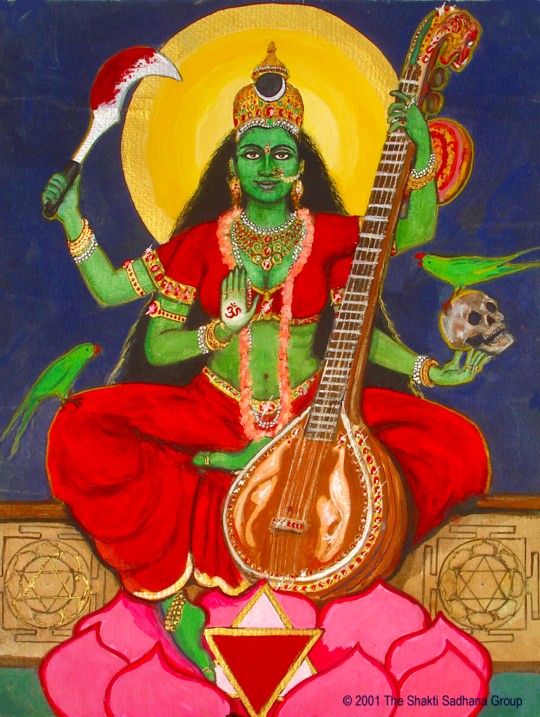
Matangi is Saraswati in her mahavidya form. She is the goddess of the arts and of happy families. In some myths she was born from the leftover scraps of the foods of the gods. She is therefore the goddess of pollution. We do not need to be pure to express our passions for all things creative. She is the goddess of attraction, whatever she wants she can have....She plays the Vina...

Yesterday I felt her energy within me and as I put it to a friend,
"Matangi came to me this morning as I pondered the unwanted polluted parts of myself. Just had another read through David Kinsey's theoretical take on the myths of her and feel quite a
few resonances with her dark attractive powers.....hmmm don't want to be her
just shine the light on me that is her in spite of my goody goody pure seeking jnana yoga self....."

This morning after Yoga and meditation Nyck and I chanted to Lakshmi....who like the last Mahavidya Kamalatmika is the energy which manifests the ultimate joys of our creative endevours. Ho... to all you creative wise beings out there!

Wednesday, June 28, 2006

Karma yoga

Karma means action- take action- but what is that action? Is it merely doing or is it the action of complete surrender. Is it the ego assuming there is something it must do in order to be? Or is it just that in the being is the doing? Once the bow is drawn the arrow is already shot. The mere intention of action is action."In tension". As humans we long to be free of tension but with out tension no action can be taken. It is the paradox of life. To do or not to do, that is the being....

In yoga practice we say release the tension, let the arrow fly, let go feel that you are allready there, in fact all that is and ever was is pouring through you at this very moment. The moment, arrows flying, actions resolving themselves ,new actions being created. Swami Sivananda said " be good " "be good, then do good" Can we accept that we are good and that our purpose is to string the bow, aim the arrow and shoot, and that that flying arrow leads us from moment to moment?

Sometimes I feel like the arrow, my master has taken aim, but I have no idea about the mark, other times my gaze is as steady as the archer and I don't even need to look to shoot. I am guided by the one true soul of me.

Trusting Trusting

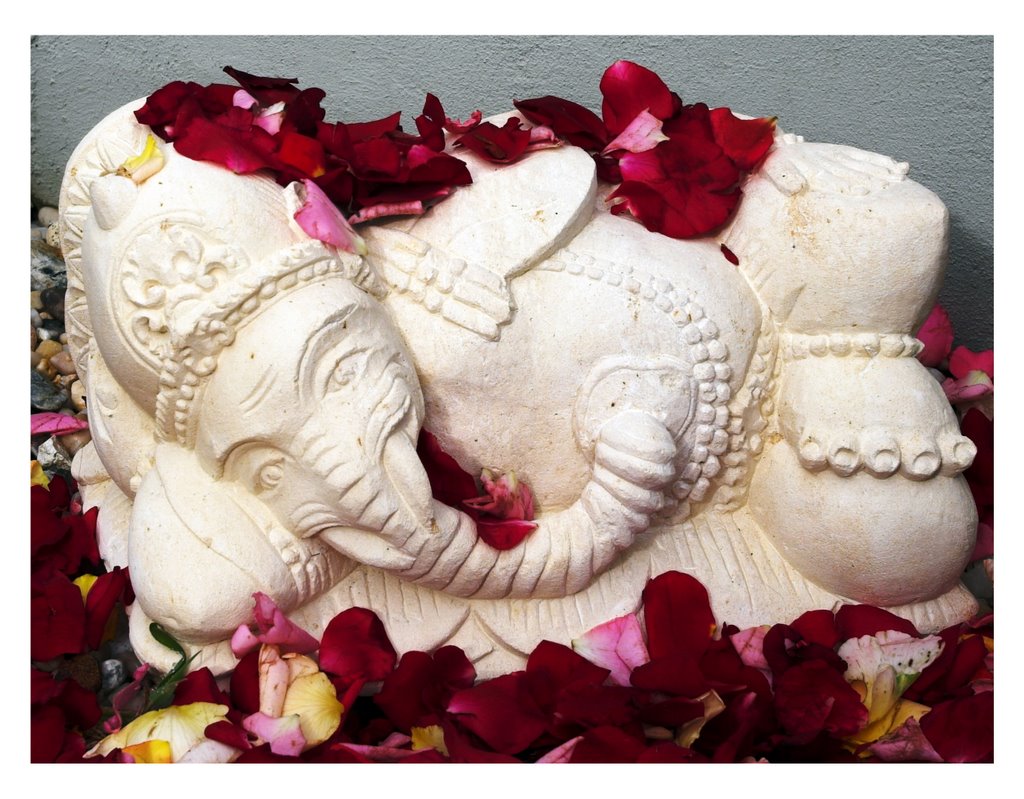
Photo of Ganesh by Tao Jones

Tuesday, June 27, 2006

Deeper meditation

meditating on the form
deeply moving in
my form is light
the body and its structures
placed carefully in asana
moved by the breath
my tratakam gaze
pulling me in in
I visualise my temple heart
and in it
ganesha ganesha always ganesha

just read a bit by Venkatesananda about the Gerandha Samhita and the three types of meditation- Sthula dhyana, Jyoti dhyana and Shuksma dhyana
moving from more complex forms of visualisation to more subtle

Here is what he says:

"Even so, sthula-dhyana has its place in the scheme of yoga. If the mind is not subtle (being gross and body-conscious), it will not be capable of entering into the subtle regions of contemplation that has often compared to jumping on one's own shoulders. However great an acrobat you may be, a body-conscious, unsubtle mind will not be capable of jumping on its own shoulders. The yogis, realizing this, suggest that it is most advantageous to realize what stage of development one is at, so that one can adapt one's meditation to that stage of development. If all one knows of oneself is "I am the body, gross, physical, material," then it is suggested that this special materialistic approach towards truth called sthula-dhyana be used.

Even should one realize that the earth is extremely subtle, and not what it appears to be through the gross instrument of the human eye, that it is also a mass dancing electrons, subtle, as energy is subtle, if in one's present state of development the earth is seen as solid, let the contemplation of the divine, of the supreme spirit, also be of something solid. There is no harm in proceeding with this, unless, of course, you start insisting that everyone else must do the same, or worse, use it as a stick to beat everyone else into submission:

"The book says to see the ocean! It's prescribed in THE BOOK! Poor man, not to have seen the ocean!"

It is totally inappropriate to force one's own visualization upon someone else. Each must find their own type of visualization. It's not even a question of remaining within the boundaries of one culture verses another. Even within what you think of as your own culture, there are thousands of variations. Some devotees may visualize a crucifix, while others don't even like the symbol of the cross. Some devotees may prefer to visualize a human form. Others would never dream of using a human figure in a visualization of the Divine. Each will have to find his or her own inner predisposition. The only principal that applies to all is the underlying reason for performing this type of meditation: I am body-conscious at present, and therefore, I need a physical symbol upon which the mind can rest, and focus."


Photo of a young swami Venkatesananda by Alan Finger

Monday, June 26, 2006

feeling

sensitive like fine hairs on a fern
when you pass by it curls
green
green the color of my heart
wishing I didn't feel so much
knowing I need to feel
something
but nothing would be better
I think
the thoughts roll
I lie around in this thick soup of me
dreaming pumpkins

Today I went to have a session with my favorite Ayurvedic practitioner Jacinta here in Byron. As usual it was deep, After being prescribed as having sadhaka pitta out of balance I poured back through my Ayurvedic books to see what it really meant.

The literal definition is" Sadhaka pitta is the fire that determines what is the truth or reality. It is located in the brain and in the heart and allows us to accomplish the goals of the intellect, intelligence and ego. these include worldly goals of pleasure wealth and prestige and the spiritual goal of liberation. It governs our mental energy, mental digestion and our power of discrimination. Its development is emphasized in Yoga particularly the yoga of Knowledge" David Frawley from his book Ayurvedic Healing

That about sums it up for me today....

I

Sunday, June 25, 2006

Going deeper with the chakras

I have just read a page from Swami Venkatesanada's talks at Yashodara Ashram and he shares some fascinating perspectives on the chakras. He says that really we can't prove where the chakras are, we can only imagine them as being placed in certain locations while taking the image-in. Some people can verify the exact locations through their study of scriptures, but really we can't know. We can only experiment for ourselves. He is however, passionate about visualisation and sees the many different images given for the chakras as a way to go deeper and deeper eventually absorbing your self into the root of the image. In other words you start with the simplest image at the base chakra which is the yantra of the golden square and then like a complex tibetan buddhist yantra you can add more shapes, animals, deities and so on... the same thing occurs with the sounds at first you visualise the four sanskrit syllables on the four petals of the lotus until they are absorbed into the one sound which is LAM. Lam is then absorbed into the next chakra like earth settling to the bottom of water in a flowing stream. I am quite inspired by his description as it gives me permission to be as simple or as complex with my visualisations in meditation. Sometimes I need to see each aspect and other times just the sense of it balancing through the mantra and yantra is enough.....